
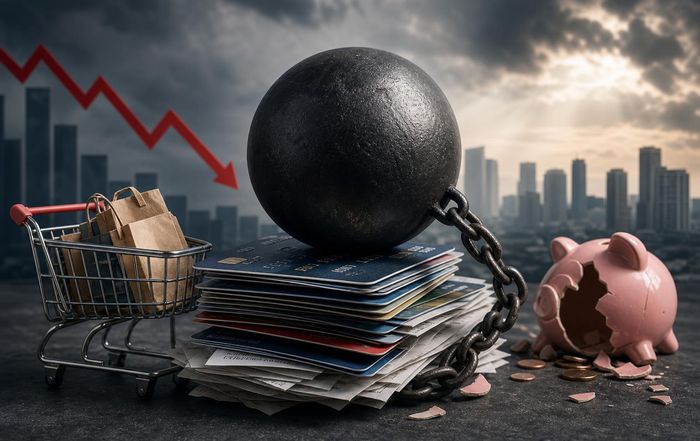
The Role of Consumer Debt in Economic Slowdowns
Consumer debt sits at the heart of modern economies. It helps households smooth spending, finance big-ticket purchases, and support business revenues. Yet the same borrowing that powers growth in good times can deepen downturns when conditions change. Understanding how consumer debt interacts with economic slowdowns has become more urgent as households worldwide grapple with higher interest rates, stubborn inflation, and rising living costs.
This feature examines how household borrowing fuels expansions, why high debt levels can amplify recessions, and what policymakers, lenders, and consumers can do to reduce the risks. It draws on recent data from major economies and highlights the implications for businesses, investors, and workers.
Why consumer debt matters for growth
In most advanced economies, household consumption represents well over half of GDP. In the United States, consumer spending accounts for roughly 70% of economic output, according to the U.S. Bureau of Economic Analysis (bea.gov). When households borrow to buy homes, cars, appliances, or services, they are not just improving their own standard of living; they are also supporting jobs, corporate profits, and tax revenues.
Over the past few decades, several forces have encouraged the expansion of household credit. Financial deregulation, the growth of securitization, and innovations such as credit scoring have made it easier for banks and non-bank lenders to extend credit to a wider population. Institutions such as the Bank for International Settlements (bis.org) and the International Monetary Fund (imf.org) have documented how household debt-to-income ratios rose steadily in many advanced economies in the run-up to the global financial crisis and again during the era of ultra-low interest rates that followed.
From a growth perspective, this expansion of credit can be beneficial. When wages are stagnant or uneven, credit allows households to maintain or increase spending, supporting retail sales, services, and housing markets. For businesses and investors following consumer-driven sectors, tracking household credit conditions is as important as monitoring corporate balance sheets or broader market trends. However, the same mechanisms that support growth can create vulnerabilities when conditions reverse.
When borrowing becomes a drag: the debt overhang problem
The key risk is not consumer debt itself, but excessive leverage relative to income, savings, and future earning prospects. Economists often talk about a "debt overhang" when households have borrowed so much that a large share of their income must go to servicing debt rather than spending. In this situation, any negative shock-job loss, higher interest rates, or falling house prices-can trigger a sharp pullback in consumption.
Research from the Bank of England (bankofengland.co.uk) and other central banks has shown that highly indebted households cut spending more aggressively during downturns than those with lower leverage. This is partly psychological-fear of default or bankruptcy-and partly mechanical, because mandatory payments on mortgages, credit cards, or auto loans leave less room to adjust. When enough households are in this position, the aggregate effect can turn a mild slowdown into a deeper recession.
The composition of debt also matters. Secured borrowing such as mortgages is typically cheaper and longer-term, but it is tied to asset prices. If housing markets weaken, heavily indebted homeowners can find themselves in negative equity, limiting their ability to refinance or move. Unsecured debt-credit cards, personal loans, buy-now-pay-later products-tends to carry higher interest rates and more variable terms. Rising rates or tighter credit standards can quickly squeeze borrowers, especially in economies where variable-rate lending is common. For readers tracking financial conditions or employment trends, shifts in household debt service burdens are a leading indicator of stress.
Interest rates, inflation, and the new pressure on households
The global environment has shifted sharply since the era of near-zero interest rates that followed the 2008 crisis and the pandemic. Central banks including the U.S. Federal Reserve (federalreserve.gov), the European Central Bank (ecb.europa.eu), and others have raised policy rates to combat inflation, pushing up borrowing costs across mortgages, credit cards, and consumer loans.
In the United States, data from the Federal Reserve Bank of New York suggests total household debt has hit record nominal levels, with mortgage balances the largest component but credit card and auto loan balances also climbing. Similar patterns are visible in parts of Europe, Canada, Australia, and other advanced economies tracked by the OECD (oecd.org). While higher nominal debt levels are not necessarily alarming on their own-because incomes and population also grow-what matters is the ratio of debt service to disposable income, and how quickly that ratio is rising.
At the same time, many households are still dealing with the after-effects of elevated inflation. Even as headline inflation moderates in some regions, the cumulative increase in rents, energy, and food prices has eroded real purchasing power. For lower- and middle-income households, this often means using credit to bridge the gap between wages and living costs. As a result, some of the recent growth in consumer borrowing reflects financial stress rather than confidence. For businesses and investors, this distinction is critical: borrowing driven by optimism tends to support sustainable demand, whereas borrowing driven by necessity may precede a future pullback.
The interaction of higher rates and elevated prices can therefore make economies more vulnerable to slowdowns. As central banks keep policy rates restrictive to ensure inflation is contained, more borrowers roll off older, cheaper loans onto higher-rate products. The lagged effect on household budgets can show up months later as slower retail sales, weaker housing activity, and rising delinquencies-developments closely watched by market participants and policymakers alike.
How consumer debt amplifies recessions
When an economy slows, several channels link household debt to deeper or longer downturns. First is the direct consumption channel: indebted households cut discretionary spending earlier and more sharply than others. They may delay travel, reduce restaurant visits, or postpone non-essential purchases. This hits sectors such as retail, hospitality, and travel especially hard, leading to layoffs that further reduce income and spending-a classic negative feedback loop.
Second is the credit supply channel. As delinquencies and defaults rise, lenders tighten underwriting standards, raise interest margins, or cut back on riskier lending altogether. This can be seen in periodic surveys by central banks and regulators, which often show banks tightening lending criteria during or just before recessions. Non-bank lenders and fintech platforms, which had expanded aggressively in some markets, may pull back even more quickly if their funding costs rise or investors become cautious. For households already on the edge, reduced access to credit can force abrupt spending cuts.
Third is the housing and wealth effect channel. In economies where mortgages dominate household balance sheets and homeownership is widespread, changes in house prices can significantly affect perceived wealth and borrowing capacity. The global financial crisis illustrated how a housing downturn, combined with high leverage and complex securitization, can transmit household stress into the broader financial system. While post-crisis reforms have generally improved bank resilience, pockets of vulnerability remain, especially in markets with rapid house price growth and high loan-to-income ratios. For readers following global economic trends, household debt levels are now a standard part of macro risk analysis.
Finally, there is a distributional channel. Debt burdens are not evenly spread: younger households, renters, and lower-income groups often carry higher-cost debt relative to their income. When shocks hit, these groups cut back hardest, exacerbating inequality and dampening demand in sectors that rely on mass-market spending. This can influence political and policy responses, from calls for debt relief to changes in bankruptcy laws or consumer protection regulations.
Different economies, different vulnerabilities
The role of consumer debt in slowdowns varies significantly across countries, depending on financial structures, regulation, and social safety nets. In the United States and United Kingdom, for example, unsecured credit and variable-rate mortgages are more common than in some continental European countries, where fixed-rate mortgages and stricter lending rules are more prevalent. This means monetary policy changes can hit household budgets faster in some jurisdictions than others.
In Nordic countries such as Sweden and Norway, regulators and central banks have expressed concern about high household debt relative to income and elevated housing prices, even though financial systems remain robust. In parts of Asia, such as South Korea, household debt has grown rapidly over the past decade, prompting policy measures to cool property markets and tighten loan-to-income caps. Emerging markets face additional risks from currency mismatches and external funding conditions, especially when global financial conditions tighten.
International bodies like the Bank for International Settlements and the IMF have repeatedly warned that rapid household debt growth is often a predictor of future financial stress, even if headline default rates remain low in the short run. Their research suggests that economies with large pre-crisis buildups in household leverage tend to experience deeper and more prolonged recessions when shocks occur. For investors, multinational businesses, and policymakers, comparing household debt metrics across countries has become a standard part of assessing macro resilience and global risk.
Policy responses: cushioning the impact without fueling bubbles
Governments and central banks face a delicate balancing act. On one hand, they want credit to remain available so that households can smooth consumption and support growth. On the other, they must avoid fueling unsustainable borrowing that increases the severity of future downturns. The policy toolkit has evolved since the global financial crisis, with greater emphasis on so-called macroprudential measures.
Central banks and regulators now commonly use tools such as loan-to-value (LTV) and debt-to-income (DTI) caps on mortgages, countercyclical capital buffers for banks, and stress testing of lender portfolios. Institutions like the Bank of England, the European Central Bank, and the Federal Reserve publish regular financial stability reports that highlight household debt vulnerabilities and outline supervisory responses. These measures aim to lean against credit booms without relying solely on interest rates, which are blunt instruments that affect the entire economy.
Fiscal policy can also play a role in mitigating the impact of debt during slowdowns. Targeted support such as temporary income transfers, unemployment benefits, or energy subsidies can help households meet essential expenses without resorting to high-cost borrowing. Some countries have experimented with mortgage forbearance schemes or temporary payment holidays during acute crises, such as the COVID-19 pandemic. However, poorly designed interventions risk encouraging moral hazard or propping up unviable borrowers, so policymakers must weigh short-term relief against long-term incentives.
Consumer protection and financial literacy initiatives are another important dimension. Regulators in many jurisdictions have tightened rules around high-cost credit, disclosure, and affordability assessments. Organizations such as the OECD and national consumer agencies have emphasized the need for clearer information about interest rates, fees, and the risks of revolving credit. For readers interested in sustainable finance, responsible lending and borrowing are increasingly seen as part of a broader push toward more resilient and equitable financial systems.
How businesses and investors should read household debt signals
For companies, especially those in consumer-facing sectors, understanding the dynamics of household debt is essential for planning, pricing, and risk management. Retailers, travel operators, automakers, and housing-related industries are particularly sensitive to shifts in credit conditions and consumer confidence. Monitoring indicators such as credit card delinquencies, auto loan default rates, mortgage refinancing activity, and lender earnings guidance can provide early signals of changing demand.
Investors, meanwhile, use household debt metrics as part of their macro and sectoral analysis. Rising delinquency rates can signal trouble not only for lenders but also for sectors reliant on discretionary spending. Conversely, periods of rapid credit growth may boost near-term earnings but raise questions about sustainability. Asset managers, banks, and fintechs increasingly incorporate household balance sheet data into stress tests and scenario planning, linking it to market volatility, housing cycles, and currency risk.
From a strategic perspective, businesses that rely heavily on consumer financing-whether through in-house credit, partnerships with lenders, or embedded finance models-need to ensure their own resilience. This can involve tightening underwriting standards, diversifying revenue streams, or building more flexible cost structures that can adjust when consumer demand softens. For founders and executives following business and startup coverage, understanding how customer indebtedness shapes demand is as important as tracking interest rates or competitor moves.
Household strategies: managing debt in an uncertain cycle
While macro policy and institutional behavior are critical, the decisions of millions of individual households ultimately determine how consumer debt interacts with slowdowns. In an environment of higher rates and uncertain growth, several principles stand out, even if their application varies by country and personal circumstances.
First, the structure of debt matters as much as the total amount. Fixed-rate mortgages or loans can provide protection against rate hikes, while variable-rate or short-term high-interest products can become dangerous if conditions change. Second, building buffers-through savings, insurance, or flexible employment-can reduce the need to rely on credit when shocks occur. Third, being realistic about future income growth is crucial; borrowing assumptions that made sense in a period of ultra-low rates and strong labor markets may no longer hold.
Financial regulators and central banks, from the Federal Reserve to the Bank of England and the ECB, regularly publish consumer-oriented materials on interest rates, debt, and budgeting on their main sites. Independent non-profit organizations and academic institutions also offer guidance on managing credit responsibly. For readers tracking personal finance and investment themes, aligning household leverage with long-term goals and risk tolerance is increasingly seen as part of a broader wealth management strategy.
A more cautious credit cycle
The role of consumer debt in economic slowdowns is neither uniformly destructive nor uniformly benign. Credit is a powerful tool that, when well managed, helps households invest in housing, education, and durable goods, while sustaining business revenues and employment. Problems emerge when borrowing outpaces income, asset prices detach from fundamentals, or lenders and borrowers underestimate the possibility of shocks.
As economies adjust to a world of higher interest rates, aging populations, and technological change, the next phase of the credit cycle is likely to be more cautious than the last. Policymakers will continue refining tools to curb excesses without choking off growth, lenders will reassess risk models shaped by a decade of cheap money, and households will confront the real cost of debt more directly.
For businesses, investors, and workers alike, paying close attention to household balance sheets is no longer optional. Consumer debt has moved from being a background condition of modern economies to a central variable that can determine whether a slowdown remains manageable-or turns into something more severe. Understanding that link, and acting on it early, is now a core part of navigating the global economy.
